The Children and Families Act 2014 defines SEN as:
- A child has a special educational need if they have a learning difficulty, or disability that calls for special educational provision.
- A learning difficulty is a significantly greater difficulty in learning, than the majority of children of the same age.
- A disability is a disability that prevents or hinders a child from taking advantage of the facilities generally available.
- Special educational provision is provision that is additional to, or different from that which is normally available in mainstream settings. For a child under the age of 2, special educational provision means provision of any kind.
A child under school age has SEN if he or she is likely to have SEN when they reach school age or would do so if special educational provision were not made for them
The information below is provided by the Early Years SEN Team
Role of the SENCO
SEND & Inclusion Networks
SENCO Training (All sessions must be attended)
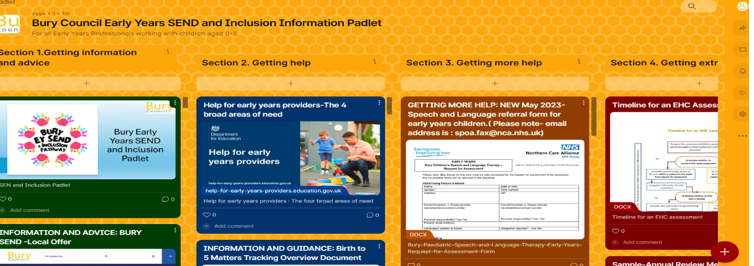
Early Years SEND & Inclusion Padlets
Please visit our EY SEND & Inclusion Padlet website which contains a variety of information and guidance
Bury EY SEND & Inclusion Pathway for Professionals
Early Years SEND & Inclusion Pathway for Parents
SEN Support – The Graduated Approach
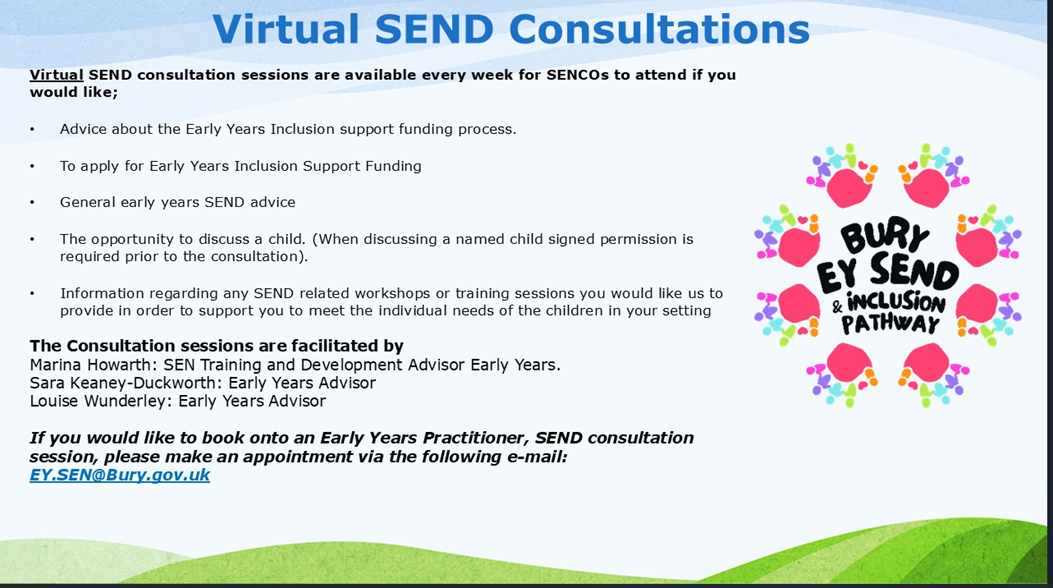
SEND & Inclusion Consultations
Early Years Inclusion Funding Process
Every Local Authority must have an SEN inclusion fund to support early years providers in meeting the needs of individual children with SEND.
Most children with additional or special educational needs will not require special resources or enhanced staffing to be successfully included in a setting. Most providers will meet the additional needs of their children very well.
However, funding can be awarded to support the inclusion and participation of children with emerging/severe/complex needs and/or a disability that are accessing their Education Entitlement with an Early Years provider.
Some children may need additional funding to provide short-term interventions to support their learning and development.
For other children it is likely that they will need additional funding for a longer period due to their SEND needs. They might need educational provision that is additional to and different from that is typically provided by Early Years settings and schools.
Early Years Inclusion Funding is additional funding that supports the access and inclusion of children with SEND living in Bury, whether a diagnosis has been made or not.
An Education, Health, Care Needs Assessment (EHCNA) may be required.
Bury has adopted a three-tiered approach to funding and thinking about children’s needs.
Early Years Inclusion Funding Paperwork
- Early Years SEND Inclusion Funding Process
- Early Years Inclusion Funding Request
- Guidance completing Early Years Inclusion Funding Request
Transitions
Transitions relate to change, but we recognise and understand that transitions are a process, NOT just an event.
Every child is an individual, and their transition support needs to be personalised according to their unique profile of strengths and differences particularly children with SEND.
Transition Support Paperwork
- SEN Transition support planning
- Transitions for children with SEND
- Understanding and supporting transitions
Last updated: 13th August 2026 at 10:30